


How is a Copyright Different from a Patent? A Clear Guide for Anyone Trying to Protect an Idea
You’ve got an idea. It might be written down, sketched out, or already partially built. And then the real confusion starts, not about the idea itself, but about protection.
How is a copyright different from a patent? It may sound like a technical legal question, but it has a real-world impact. Choosing the wrong type of protection doesn’t just create confusion; it can leave parts of your work unprotected.
At a high level, the answer is simple: copyright and patents protect different kinds of intellectual property, and the differences become apparent when you see how each one actually operates in real situations.
What Copyright and Patent Mean
Before comparing them, it’s important to understand what each one is designed to do.
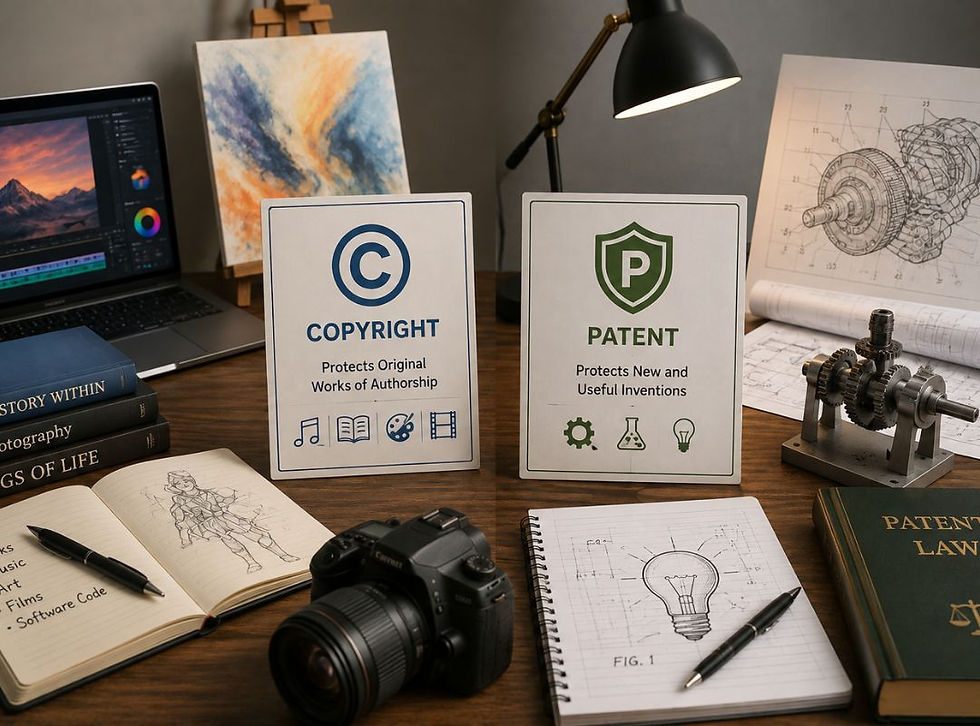
Copyright protects original creative work or artistic expression: things like writing, visuals, music, and digital content. It protects how something is expressed.
A utility patent protects inventions that function. This includes machines, systems, processes, or technical solutions that solve a problem in a new way. Note that there is a wrinkle in that a patent can also be a design patent, which protects the visual ornamental appearance of an article. Because of that, design patents and copyright may often protect the same elements.
So when people ask how is a copyright different from a patent, they’re really trying to understand what type of work belongs where.
How Each One Works in Real Life
Think about a written guide explaining how a device works. The text, explanation, and structure are protected by copyright. But if the device described in that guide is new and functional, the underlying invention may require a patent.
This is where most confusion happens. People assume the document and the invention are protected in the same way, but they are not. And this is exactly why understanding how is a copyright different from a patent matters before you share or file anything.
What Each One Does NOT Protect
Copyright does not protect ideas, methods, or systems. It only protects the way those ideas are expressed.
A patent does not protect abstract concepts. It only protects inventions that are specific, functional, and technically defined.
This is an important distinction because many people assume ownership begins the moment an idea is created. In reality, protection only applies once the work fits the correct legal category.
So when someone asks how is a copyright different from a patent, this is the gap they are usually missing.
What Happens When You Choose the Wrong Protection
Choosing incorrectly doesn’t just slow things down, it can change what you actually own.
If something functional is only protected under copyright, the underlying mechanism may still be copied or recreated by others. If a patent is delayed or not filed properly, the invention may lose protection once it becomes public.
This is where the differences become a practical risk question, not just a theoretical one. Most issues don’t come from lack of protection, but from using the wrong type of protection.
Can Copyright and Patent Work Together?
Yes, but they apply to different layers of the same idea.
A single product or concept can have:
Copyright protection for documentation, design, or written material
Patent protection for the actual functional system or invention
How Decisions Are Actually Made
In practice, the decision isn’t about choosing one over the other blindly.
It comes down to three things:
What exactly is being created
Whether it is expressive or functional
What level of protection is actually needed
This is where many inventors and founders get stuck, not because the system is complex, but because the distinction is not explained in practical terms.
Final Perspective
At its core, the answer to how is a copyright different from a patent is not just legal, it’s structural. Copyright protects expression. Patents protect function. But more importantly, they protect different kinds of value. Once you understand that, the decision becomes less about confusion and more about clarity.
Work With Sleman & Lund LLP
If you’re trying to understand whether your idea can actually be protected, the first step is proper evaluation, not assumptions.
Sleman & Lund LLP is a boutique patent law firm focused exclusively on patent preparation, prosecution, and strategic intellectual property guidance.
We work primarily with:
Medical device inventions
Mechanical systems
Selected software-based innovations
Core services include:
Patent Preparation & Filing
Patent Search
Patent Legal Opinions (FTO, validity, non-infringement)
IP Strategy & Counseling
We hold expertise in making your patent process easier, contact us today!
FAQs
How is a copyright different from a patent in simple terms?
Copyright is for things you create in an expressive form like a blog, artwork, music, or visuals where the focus is on how it is presented. A patent is for something you’ve built or developed that actually performs a function or solves a problem in a practical way.
Do I need copyright or a patent for my idea?
It really depends on what your idea looks like in real life. If it’s creative content or expression, copyright is usually enough. But if it’s a product, mechanism, or system that works in a specific way, then a patent is the right form of protection.
Can something have both copyright and patent protection?
Yes, and this happens more often than people think. For example, the written explanation, documentation, or design around an invention can be protected by copyright, while the actual invention or working mechanism can be protected through a patent.
Do I automatically get copyright or do I need to apply for it?
In the US, copyright exists automatically the moment you create and fix your work in a tangible form, like writing it down or publishing it. You don’t need approval for basic protection, but registering it gives stronger legal backing if there’s ever a dispute.
Can a patent protect an idea before it is built or launched?
No, a patent cannot protect just an idea on paper. It only applies once the invention is clearly defined and technically detailed enough to be filed, even if it hasn’t been commercially launched yet.
Comments