


How to Patent an EV or Automotive Invention: What Founders Need to Know
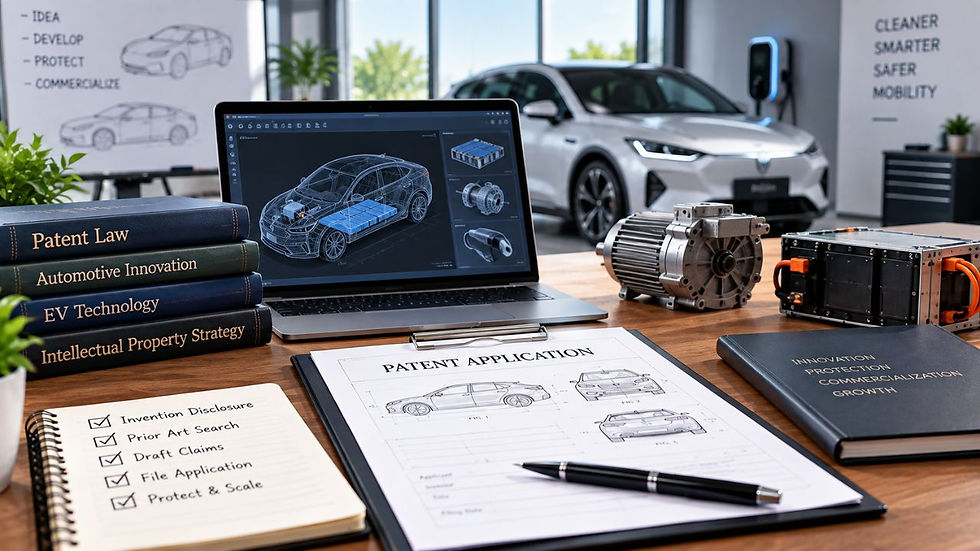
The automotive industry is changing quickly. Electric vehicles, battery systems, charging technology, autonomous driving, vehicle software, sensors, thermal management, and connected-car systems are creating new opportunities for startups and established manufacturers alike.
However, for founders, having a technically impressive automotive invention is only part of the equation. The bigger question is how to protect it before competitors develop similar technology or the invention is publicly disclosed.
Understanding how to patent an automotive or EV invention starts with identifying the specific technical innovation, evaluating its patentability, and developing a filing strategy that supports the company's long-term goals.
What Automotive and EV Inventions Can Be Patented?
A wide range of automotive technologies may qualify for patent protection when they meet the applicable requirements for patentability. Potentially patentable EV and automotive innovations include:
Battery architecture and battery-management systems
EV charging systems and charging controls
Thermal management and cooling technology
Electric motors and power electronics
Regenerative braking systems
Autonomous or assisted-driving technology
Vehicle sensors and communication systems
Vehicle-control software with a technical implementation
What Makes an EV or Automotive Invention Patentable?
Founders should evaluate patentability before spending significant resources on an application. In the United States, a patentable invention generally needs to satisfy requirements such as novelty, non-obviousness, usefulness, and adequate disclosure.
For example, saying that an EV should "charge faster" is not enough by itself. A specific charging architecture, control technique, battery configuration, or thermal-management solution that achieves that result may provide the technical substance needed for patent protection.
Why Should EV Founders Conduct a Patent Search Before Filing?
Automotive and EV technologies are highly competitive, with decades of existing patents and technical publications already in the field
.
A patentability search can help identify:
Similar patented technologies
Published patent applications
Relevant non-patent literature
Potential prior art
Competitor innovation
Opportunities to distinguish your invention
How to Patent an Automotive or EV Invention Step by Step
Document the Technical Innovation
Start by documenting what the invention does, how it works, what problem it solves, and what makes it different. Useful materials can include:
Engineering drawings
CAD files
Schematics
Prototype information
Testing data
System diagrams
Software flowcharts
Technical specifications
Do not focus only on the final commercial product. Document alternative implementations and variations as well. These details can become valuable when drafting claims and responding to patent examiner objections.
Identify the Inventors
Correct inventorship is essential. Founders should determine who actually contributed to the inventive concept rather than simply listing company executives, investors, or employees.
This issue can become particularly important for startups where founders, engineers, consultants, university researchers, and outside developers may all contribute to the technology.
Perform a Patentability Search
A professional search can reveal whether similar technology has already been disclosed.
For an EV invention, the search might cover multiple technical areas simultaneously. For example, a battery invention could involve battery chemistry, mechanical packaging, thermal management, electronics, and software controls.
Decide Between a Provisional and Nonprovisional Application
Some U.S. startups choose to begin with a provisional patent application. A provisional application can establish an early filing date without immediately beginning examination, giving the inventor time to continue developing the technology and prepare for a later nonprovisional application.
However, a provisional application should not be treated as a placeholder with minimal information. The eventual patent claims generally need support in what was adequately disclosed in the earlier filing.
Draft Claims Around the Real Innovation
Patent claims define the legal boundaries of the protection being sought.
For an automotive invention, claims might focus on a particular arrangement of components, a control method, a system architecture, or a combination of technical elements.
The challenge is finding the right balance. Claims that are too narrow may leave competitors room to design around the patent. Claims that are too broad may face prior-art or obviousness rejections.
This is why strong patent drafting requires understanding both the technology and the business objectives behind it.
File and Navigate Patent Prosecution
After filing, the application enters the patent prosecution process. The USPTO may issue office actions raising objections or rejections. The applicant can respond with arguments, amendments, and other appropriate submissions.
Patent prosecution is not simply a paperwork exercise. The way claims are amended and defended can significantly affect the scope and commercial value of the eventual patent.
Should Founders Patent the Whole EV or Individual Technologies?
Usually, founders should think beyond the vehicle as a single product.
An EV may contain numerous separate innovations. For example, a startup could have patentable technology related to its battery cooling system, charging algorithm, motor controller, vehicle structure, or autonomous driving system.
Depending on the technology and business strategy, these innovations may support a portfolio rather than a single patent.
A portfolio can create broader strategic value by protecting different aspects of a product and making it harder for competitors to replicate the company's core technology.
Patent Protection Is Different From Freedom to Operate
Obtaining a patent does not automatically mean a company is free to manufacture or sell its product.
A patent gives its owner certain exclusionary rights; it does not necessarily provide permission to practice every aspect of a commercial product.
For example, an EV startup could obtain a patent on an improved charging system while another company holds a patent covering a separate technology incorporated into that charging system.
Protect Your EV Innovation Before Public Disclosure
Timing matters.
Founders often want to demonstrate a prototype to investors, publish technical information, launch a website, attend trade shows, or begin commercial discussions. Public disclosure before filing can create serious patent risks, particularly when international protection is important.
A safer approach is to discuss the filing strategy with patent counsel before publicly revealing the invention.
We Help Automotive and EV Innovators
For an EV or automotive startup, that combination can be valuable because modern vehicle inventions frequently cross multiple technical disciplines. A thoughtful patent strategy from Sleman & Lund LLP can help founders determine what should be protected, how different innovations fit into an IP portfolio, and how patent rights align with the company's broader commercial plans.
FAQs
Can you patent an electric vehicle invention?
Yes. Specific technical innovations involving batteries, charging, motors, thermal management, vehicle controls, structures, sensors, and other automotive technologies may qualify for patent protection if they satisfy the applicable patentability requirements.
Do I need a prototype before filing an EV patent?
Not necessarily. A working prototype is not required in every case. However, the application needs enough technical detail to explain the invention properly.
Can automotive software be patented?
Potentially. Software-related inventions can face additional patent-eligibility considerations, but software that provides a specific technical improvement may be eligible for patent protection depending on the circumstances.
Should an EV startup conduct a patent search before filing?
Yes. A patent search can identify relevant prior art and help determine how the invention may be distinguished from existing technology. It can also inform claim and filing strategy.
Comments